
2026 Customer Success Leadership Compensation Benchmarks
Why Customer Success Leadership Compensation Is Changing
In 2026, Customer Success leadership compensation varies significantly across U.S. SaaS and technology companies. Company ARR, stage, organizational scope, team size, reporting structure, and revenue ownership all influence how a role is benchmarked.
Today’s Customer Success leaders are often being asked to help companies:
- Protect recurring revenue
- Improve gross revenue retention and net revenue retention
- Increase product adoption
- Drive expansion and customer growth
- Improve onboarding and time to value
- Build more scalable customer journeys
- Partner with Sales, Product, Support, and Services
- Lead teams through AI transformation
- Build more efficient post-sales operating models
- Strengthen the connection between customer outcomes and company growth
- And more
That shift has changed how companies should think about compensation.
A Customer Success leader may primarily own adoption and customer health.
And a different Customer Success leader may own adoption, retention, renewals, expansion, and NRR. They are carrying a different level of business accountability.
Both roles are critical. But they are not the same role. And they should be compensated accordingly.
2026 Customer Success Leadership Compensation Benchmarks
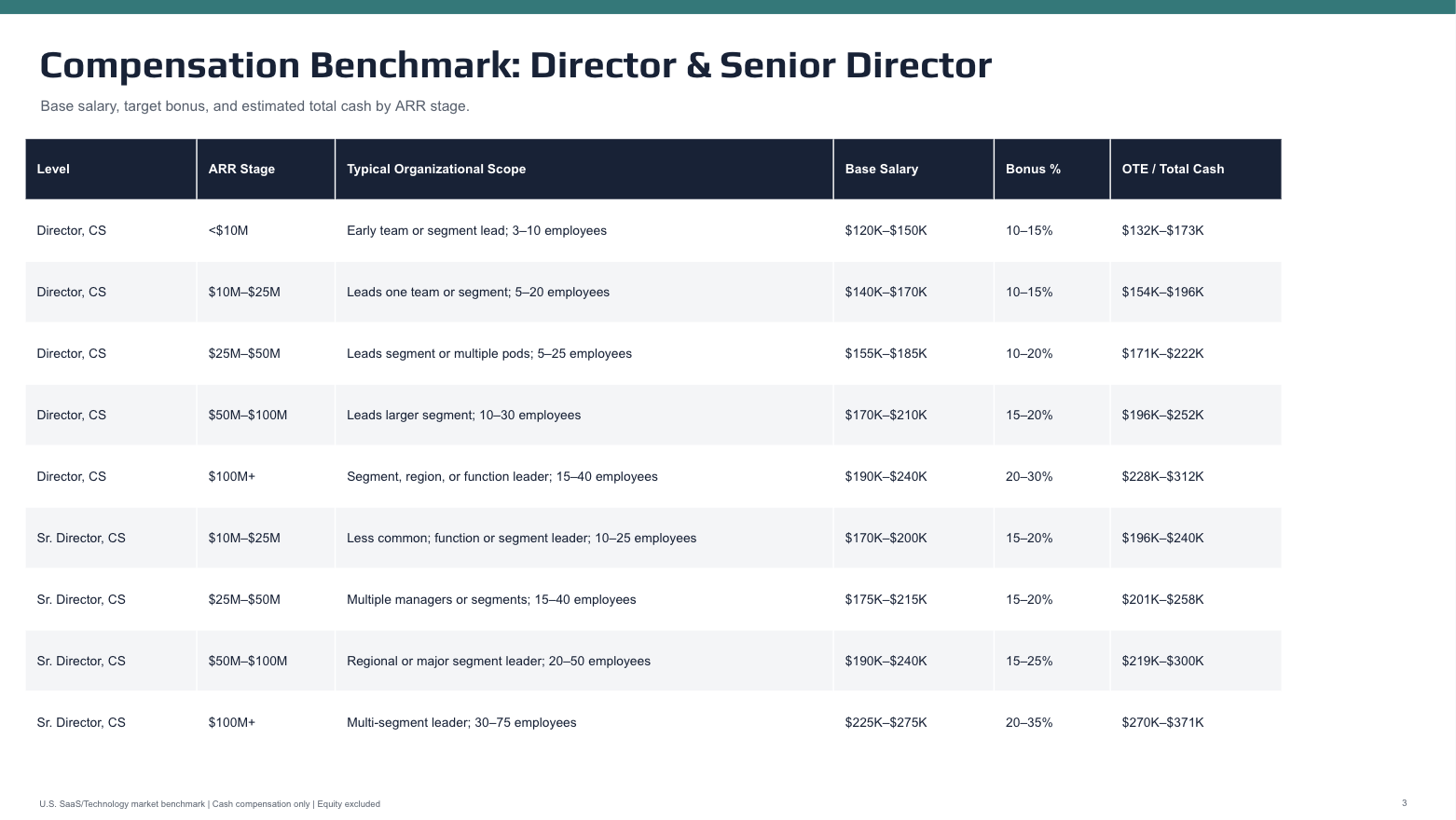
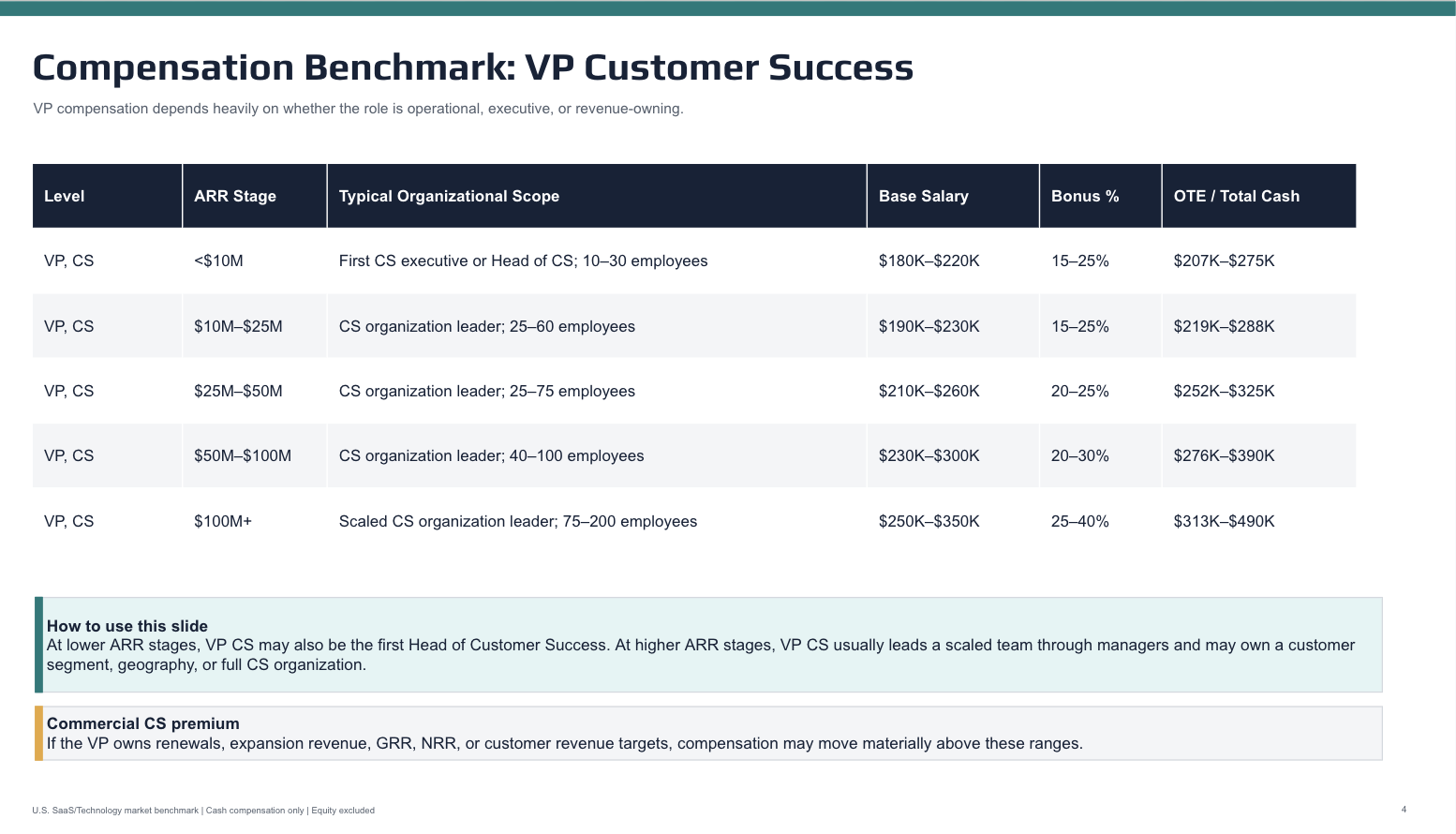
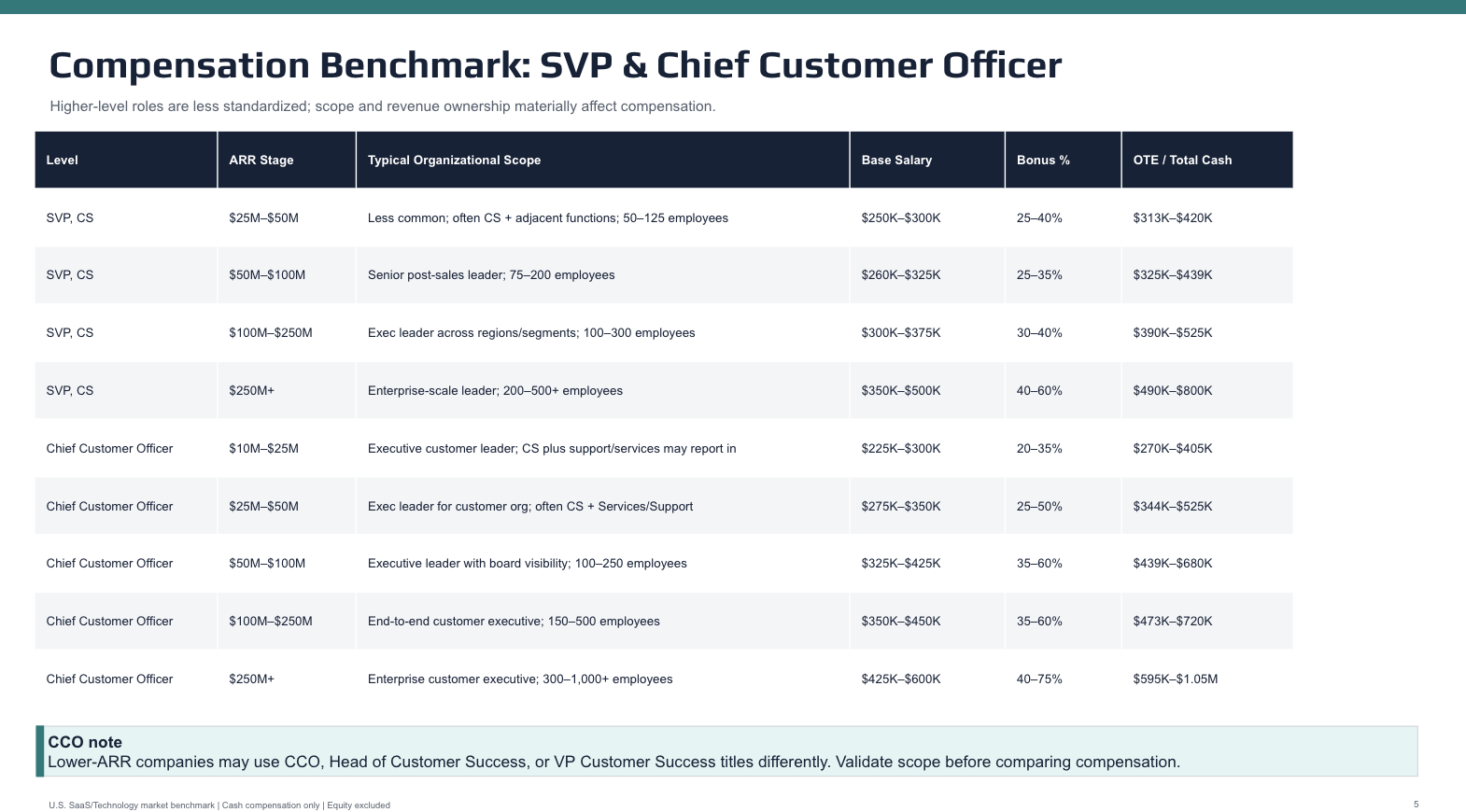
The ranges below reflect U.S. SaaS and technology companies. They are intended to serve as market-informed guidance, not as a single-source compensation survey.
These ranges include cash compensation only, meaning base salary plus target bonus or variable compensation. Equity is not included. Use these benchmarks to evaluate the salary ranges for Director of Customer Success, Senior Director of Customer Success, VP of Customer Success, SVP Customer Success, and Chief Customer Officer based on company stage.
The Biggest Compensation Driver: Revenue Ownership
The biggest factor that moves Customer Success leadership compensation up is revenue ownership.
If Customer Success owns renewals, expansion revenue, or a Net Revenue Retention target, cash compensation is commonly 15–30% higher than traditional Customer Success leadership ranges.
In some organizations, commercial Customer Success leaders are being benchmarked closer to Sales or Revenue leadership than traditional Customer Success leadership.
That makes sense. A leader who owns adoption and customer health is one level of responsibility. A leader who owns adoption, retention, renewals, expansion, and revenue protection is carrying a different level of accountability.
Before benchmarking compensation, companies should get clear on these questions:
- Does this leader own renewals?
- Does this leader own expansion?
- Does this leader carry an NRR target?
- Does this leader influence pricing, packaging, or commercial strategy?
- Does this leader own Customer Success only, or also Support, Services, Education, Onboarding, or Customer Operations?
- Is this person a functional leader or an executive operating leader?
The answers to these questions should directly influence the compensation package. They should also shape the compensation structure itself: the base salary, what variable pay is tied to and equity.
Title Alone Is Not Enough
Customer Success titles remain highly inconsistent.
This is especially true for Head of Customer Success, SVP Customer Success, and Chief Customer Officer roles.
A Head of Customer Success can sit at a Senior Director level, VP level, or true executive level depending on company stage and scope.
An SVP Customer Success role can also vary significantly by company structure. In some companies, SVP is a true executive position with broad organizational ownership. In others, the SVP title may be used for a role that more closely resembles a VP or Senior Director scope.
For this reason, companies should not benchmark compensation by title alone.
They should evaluate:
- Scope of responsibility
- Reporting structure
- Company stage
- Revenue ownership
- Team size
- Budget ownership
- Executive authority
- Board exposure
- Customer segment complexity
- Adjacent functions owned
The same title can mean very different things across different companies.
Where Does “Head of Customer Success” Fit?
Head of Customer Success is one of the least standardized titles in SaaS.
At an early-stage company, Head of Customer Success may be the first post-sales leader hired. That person may build the function, manage customers directly, create playbooks, hire the first CSMs, and partner closely with the founder or CEO.
In practice, a Head of Customer Success salary typically can range anywhere from Director-level to VP-level pay depending on scope.
At a later-stage company, Head of Customer Success may be a true executive leader responsible for the full Customer Success organization. In that case, the role may benchmark closer to VP or even CCO compensation.
This is why both companies and candidates should look beyond the title.
The better questions are:
- Who does the role report to?
- Is this person part of the executive team?
- Does the role own a budget?
- Does the role own renewals, expansion, or NRR?
- Does the role manage managers?
- Is there equity attached to the role?
- Are executive-level benefits included?
- What decisions will this person actually have authority to make?
If a company is using a Head of Customer Success title but expecting VP or C-suite outcomes, the compensation package should reflect that level of responsibility.
AI Is Changing the Customer Success Leadership Profile
AI is changing what companies need from Customer Success leaders.
Companies are not just looking for leaders who can manage teams. They are looking for leaders who can rethink how customer work gets done.
The strongest Customer Success leaders are being asked to answer questions like:
- How do we scale customer engagement without scaling headcount at the same rate?
- How do we use AI to improve onboarding, adoption, support, and customer insights?
- How do we help customers adopt AI-enabled products faster?
- How do we train teams to use AI without losing the human side of Customer Success?
- How do we redesign roles, workflows, and operating models around new technology?
- How do we make sure AI improves the customer experience instead of simply adding another layer of complexity?
Because of this, AI-native and AI-forward companies may pay a premium for leaders who can combine customer strategy, revenue ownership, operating discipline, and AI fluency.
This does not mean every Customer Success leader needs to be deeply technical.
It does mean Customer Success leaders need to understand how AI changes customer adoption, team design, productivity, enablement, and value delivery.
Equity Is a Critical Part of Compensation, Especially at the VP Level and Above
The ranges above reflect cash compensation only. Equity or other long-term incentives can represent a meaningful portion of the total compensation package, particularly for senior roles at privately held and investor-backed SaaS and technology companies.
For senior level Customer Success roles, candidates should evaluate:
- Equity percentage or number of shares
- Strike price
- Current valuation
- Vesting schedule
- Refresh grants
- Acceleration terms
- Liquidity expectations
- Change of control provisions
- Severance
- Executive benefits
- Bonus structure
- Board visibility
- Performance expectations tied to the role
Companies should also remember that senior level candidates are not evaluating base salary alone. They are evaluating the full opportunity. That includes base and variable compensation, equity, scope, influence, reporting structure, company trajectory, and the ability to make an impact.
Other Factors That Move Compensation Up
Beyond title and company stage, several factors can move compensation materially higher.
Compensation often increases when the role includes:
- Renewal ownership
- Expansion ownership
- NRR accountability
- Global team leadership
- Enterprise customer ownership
- Strategic account responsibility
- Board-level visibility
- Public company experience
- PE-backed transformation experience
- Ownership of Professional Services
- Ownership of Support
- Ownership of Customer Operations
- Ownership of Customer Education
- Responsibility for AI adoption or digital transformation
- A high-growth or turnaround mandate
The more the role directly connects to revenue protection, expansion, customer value, and company growth, the more compensation typically moves upward.
Emerging Customer Success Leadership Roles
The Customer Success executive landscape is also expanding.
Companies are creating more specialized leadership roles as customer organizations become more complex.
Some of the most common emerging roles include:
- VP, Digital Customer Success
- VP, Scaled Customer Success
- VP, Customer Success Operations
- VP, Customer Experience
- VP, Customer Growth
- VP, Customer Education
- VP, Customer Onboarding
Not every company needs every role.
But the shift is important.
It shows that Customer Success is no longer one function with one operating model. Companies are designing customer organizations around segment, scale, revenue ownership, digital engagement, AI, and measurable customer outcomes.
A VP of Digital Customer Success or VP of Scaled Customer Success may benchmark similarly to a VP of Customer Success, especially if the role owns a major customer segment, digital adoption strategy, AI-enabled engagement, or measurable revenue outcomes.
A VP of Customer Success Operations may benchmark differently depending on whether the role is strategic, analytical, systems-focused, or responsible for the operating rhythm across the entire customer organization.
The key is to benchmark the role based on business impact, not just title.
What Companies Should Do Before Making a Customer Success Leadership Offer
Before making an offer, companies should get clear on five things.
1. Define the business problem
Are you hiring this leader to reduce churn, improve onboarding, scale the team, drive expansion, improve customer outcomes, rebuild the post-sales organization, or lead an AI transformation?
The business problem should shape the profile and the compensation.
2. Define the scope
Customer Success compensation depends heavily on what the leader owns. Customer Success only is one scope. Customer Success plus Support is another. Customer Success plus Renewals, Expansion, Services, and Customer Operations is a very different role.
3. Define the level
Do you need a Director, Senior Director, VP, SVP, Head of Customer Success, or Chief Customer Officer? Do not pick the title first. Pick the business need first. Then determine the level that matches the scope.
4. Benchmark against the right market
A VP of Customer Success in a $25M ARR SaaS company should not be benchmarked the same way as a VP of Customer Success in a $500M ARR company. Company stage matters. So does geography, customer segment, revenue ownership, and reporting structure.
5. Build a package that matches the expectations
If the role requires executive-level outcomes, the package should reflect executive-level responsibility. That means looking beyond base salary and considering bonus, equity, benefits, severance, reporting structure, and decision-making authority.
The Bottom Line
Customer Success leadership compensation is becoming more complex as companies account for differences in scope, revenue responsibility, company stage, and strategic impact.
The market is moving in two directions at once. Some companies need strong leaders who can build healthy teams, improve adoption, create better customer experiences, and strengthen retention. Other companies need commercial Customer Success executives who can own renewals, expansion, NRR, digital transformation, and customer-led growth.
Both are important. But they are not the same role.
The companies that make the strongest hires are the ones that define the role clearly before going to market.
And in today’s market, that clarity matters.
It helps companies attract the right leaders, avoid title confusion, and build Customer Success organizations that are designed for the stage of growth they are in.
How Melo Associates Helps Companies Hire Customer Success Leaders
At Melo Associates, we specialize in customer-facing, revenue-driving roles across SaaS, AI native and technology companies.
We help companies hire across all revenue leadership, including Customer Success, Customer Growth, Sales, Customer Support, Professional Services, and Solution Engineering.
That includes Director, VP, SVP, Head of Customer Success, and Chief Customer Officer searches.
The companies that win these hires are usually the ones that get clear before they go to market.
Clear on the business problem.
Clear on the scope.
Clear on the level.
Clear on what success looks like.
AND clear on compensation.
Methodology and Sources
These benchmarks were developed by synthesizing recent public compensation data, SaaS salary benchmarks, executive compensation resources, and Melo Associates’ recruiting market observations across Customer Success and Revenue leadership hiring.
Sources reviewed include Salary.com, Founderpath SaaS Salary Benchmarks, Glassdoor, Indeed, Pave compensation resources, and broader executive compensation market data. AI tools supported the organization and synthesis of the information.
These ranges are intended as market-informed guidance. They should not be interpreted as a single-source compensation survey. Compensation can vary significantly based on company stage, geography, ownership structure, equity, revenue ownership, reporting structure, team size, and total rewards.
How much does a VP of Customer Success make in 2026?
A VP of Customer Success salary in 2026 depends heavily on the scope of the role. Key factors include company ARR, funding stage, team size, customer segment, reporting structure, and ownership of renewals, expansion, or net revenue retention.
At U.S. SaaS companies, base salaries may range from approximately $190K to $300K, with total cash compensation commonly falling between $219K and $390K. At companies above $100M ARR, total cash compensation may reach $313K to $490K.
However, these ranges should not be applied without considering the role’s full responsibilities. A VP leading a large global team or owning a revenue target will typically command more than a VP focused primarily on customer adoption and team leadership. Roles with direct accountability for renewals, expansion, or NRR may pay 15–30% more.
How much does a VP of Customer Success make in 2026?
A VP of Customer Success salary in 2026 depends heavily on the scope of the role. Key factors include company ARR, funding stage, team size, customer segment, reporting structure, and ownership of renewals, expansion, or net revenue retention.
At U.S. SaaS companies, base salaries may range from approximately $190K to $300K, with total cash compensation commonly falling between $219K and $390K. At companies above $100M ARR, total cash compensation may reach $313K to $490K.
However, these ranges should not be applied without considering the role’s full responsibilities. A VP leading a large global team or owning a revenue target will typically command more than a VP focused primarily on customer adoption and team leadership. Roles with direct accountability for renewals, expansion, or NRR may pay 15–30% more. Equity can also represent a substantial portion of the overall package, particularly at venture-backed, PE (private equity) backed, or high-growth companies, and is not included in these cash compensation figures.
What is the average Chief Customer Officer salary in SaaS?
There is no single average Chief Customer Officer salary that accurately applies across SaaS companies. CCO compensation varies significantly based on company size, ARR, funding stage, customer complexity, team scope, reporting structure, and revenue ownership.
At companies between $25M and $100M ARR, total cash compensation may range from approximately $344K to $680K. At companies above $250M ARR, base salaries may start around $425K, while total cash packages can exceed $1M.
The role’s scope is critical. A CCO overseeing Customer Success, Support, Professional Services, Renewals, and Expansion will typically earn more than a leader responsible for Customer Success alone. Equity can also represent a substantial portion of the overall package, particularly at venture-backed, PE (private equity) backed, or high-growth companies, and is not included in these cash compensation figures.
What factors increase Customer Success leadership compensation the most?
Revenue ownership is the biggest driver. Leaders who own renewals, expansion revenue, or a Net Revenue Retention target are commonly paid 15–30% more than leaders focused on adoption and customer health alone. Other factors that move compensation up include global team leadership, enterprise customer ownership, ownership of additional functions like Support or Professional Services, board visibility, and responsibility for AI transformation.